83% of consumers research products before buying, and 66% do so online (source : FEVAD).In recent years, the shopping experience has evolved significantly: it no longer begins and ends in a physical store but now extends across a wide range of digital channels. This multiplication of touchpoints makes the buying journey richer for consumers, but also more complex for brands and retailers to manage. This is where a key concept in digital retail comes into play: the Digital Shelf.
Definition of the Digital Shelf
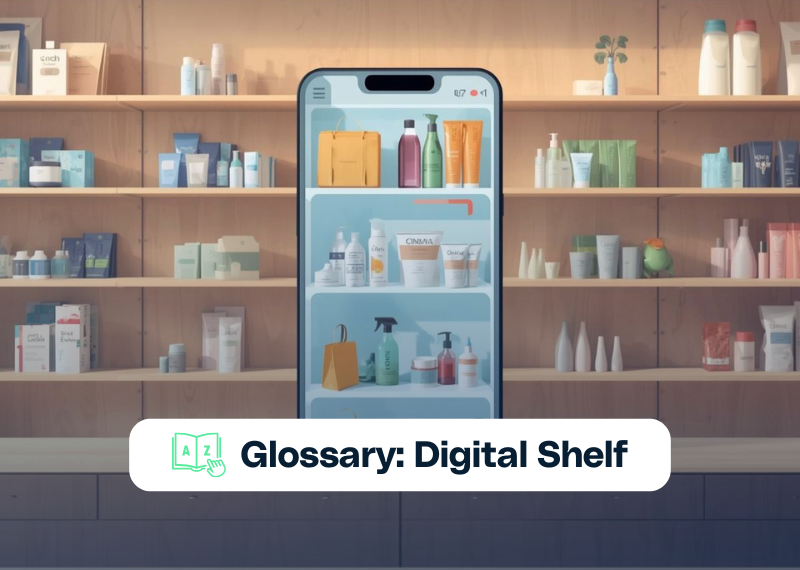
The Digital Shelf refers to all the digital spaces where consumers search for, compare, evaluate, and purchase products. It is the online equivalent of in‑store shelves, the digital showcase for your products.
Concretely, it includes:
- E‑commerce websites
- Marketplaces (Amazon, Cdiscount, Carrefour, etc.)
- D2C (Direct‑to‑Consumer) brand websites
- Search engines
- Mobile apps
- Consumer review platforms
👉 Wherever a product exists online, it is part of the Digital Shelf.
A simple example: a consumer searching for a vacuum cleaner might start with a Google search, compare several models on a marketplace, check customer reviews, visit the brand’s official website, and finally complete the purchase on a mobile app. Each of these interactions takes place on the Digital Shelf.
Digital Shelf vs. E‑commerce: What’s the difference?
The Digital Shelf extends far beyond online transactions..
- E‑commerce refers to the purchasing action.
- The Digital Shelf covers the entire digital product experience: before, during, and after the purchase.
It is therefore a much more cross‑functional concept, spanning marketing, product data, e‑retail, supply chain, and brand strategy.
What do we find on the Digital Shelf?
The Digital Shelf brings together all the elements that influence how your products are perceived and perform online:
- Product pages: titles, descriptions, images, videos.
- Prices and promotions: competitiveness and consistency.
- Customer reviews: ratings and comments.
- Availability: stock levels and delivery timelines.
- Positioning: ranking in internal search results.
Combined, these elements determine a product’s visibility, attractiveness, and conversion potential.
Why has the Digital Shelf become strategic in retail?
With the rise of e‑commerce and phygital experiences, the purchasing journey is now mostly digital, even when the final purchase happens in store. 50% of European consumers say they use both online and offline channels to research and buy products (source: McKinsey). They compare prices, analyze product features, and read reviews before making a decision.
As a result:
- The Digital Shelf directly influences sales
- It shapes brand visibility
- It impacts perceived quality and trust
A product that is poorly referenced, poorly described, or unavailable online is simply invisible.
Intensifying E‑commerce competition
Online, competition is extremely intense. Being visible is a major challenge, and the first essential step before any conversion. Strong product ranking, high‑quality visuals, and accurate information are key to appearing in search results, capturing attention, and convincing consumers within seconds.

The pillars of the Digital Shelf
To perform well on the Digital Shelf, brands must master several key dimensions.
- Visibility
Visibility refers to a product’s ability to appear at the top of search or navigation results on e‑commerce sites and marketplaces.
- Availability
A well‑ranked product that is out of stock instantly loses performance. Listing errors are especially damaging: a product may be in stock but poorly referenced, or not referenced at all, on the retailer’s website.
- Content quality
The Digital Shelf relies heavily on the accuracy and richness of product information: complete and reliable product data, compliant and attractive images, and technical specifications. Incomplete or inconsistent content harms both visibility and conversion.
- Prices and promotions
Aligned pricing and correctly applied promotions are essential to remain competitive.
- E‑reputation
Customer reviews, ratings, and comments strongly influence product perception. Online reputation is an integral part of the Digital Shelf.
The Digital Shelf in one definition
The Digital Shelf refers to all the digital touchpoints where a product is displayed, compared, and evaluated by consumers. Its performance depends on the quality of product data and content, as well as their continuous monitoring through Digital Shelf Analytics.
Going further: mastering your products’ online performance
Understanding the Digital Shelf is only the first step. The next is to measure, analyze, and continuously optimize its performance to remain competitive in an e‑retail environment increasingly driven by data and algorithms. To achieve this, many brands and retailers rely on Digital Shelf Analytics solutions, tools dedicated to monitoring visibility, content quality, availability, and the overall performance of their products across the Digital Shelf.


