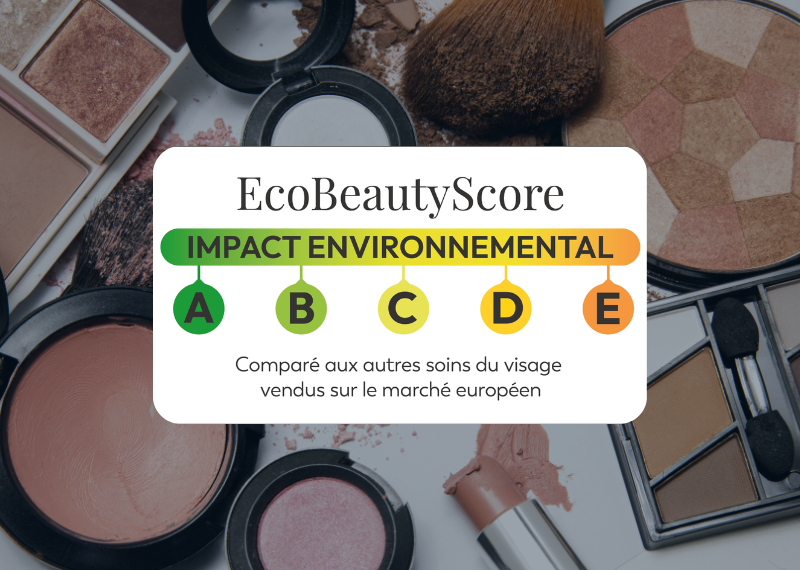
How can the beauty sector reconcile consumers’ expectations for transparency with the industry’s need to reduce its environmental impact? The EcoBeautyScore aims to provide a clear and universal rating system to compare the environmental footprint of beauty products. For brands, this is not a constraint but a strategic opportunity to structure product data, strengthen traceability, and build responsible, credible communication.
EcoBeautyScore: what is it?
This rating system was launched in 2021 by five major players in the cosmetics industry (L’Oréal, LVMH, Henkel, Unilever and Natura & Co). Now supported by more than 70 international brands, the EcoBeautyScore provides consumers with the information they need to make more informed and sustainable choices, while helping brands analyze and reduce their environmental impact.
In practice:
Similar to the Nutri-Score in the food sector, each product receives a standardized environmental rating from A to E. This assessment is based on a Life Cycle Assessment (LCA), meaning a complete study of a product’s impact—from formulation to end-of-life.
Among the criteria considered:
- Carbon (CO₂) emissions throughout the product’s life cycle;
- Total water consumption required to manufacture the product;
- Depletion of natural resources (raw materials, minerals, etc.);
- Impacts related to formulation, manufacturing, packaging, transport, use and end-of-life;
- Potential effects on air, water and soil pollution;
- Waste management and recovery (including packaging);
- Additional indicators from the Product Environmental Footprint (PEF) regulation, such as eutrophication, acidification, ecotoxicity and energy consumption.
Over the long term, EcoBeautyScore aims to support all stakeholders toward more sustainable practices through a transparent, shared methodology.
Where do we stand today?
- End of 2025: official rollout of the system across several European markets, including the United Kingdom (starting November 19, 2025);
- Initial phase: assessment of four product categories – shampoos, conditioners, shower gels and face care products;
- By 2027–2028: gradual expansion to about thirty categories, with the objective of covering all cosmetic products by 2027.
EcoBeautyScore: what does it mean for retail players?
The EcoBeautyScore is transforming practices for cosmetic retailers, both in-store and online, by introducing new requirements for transparency and environmental labeling.
What changes for retail players…
- Strengthened product transparency: displaying a clear, comparable and verifiable score for each item;
- Product data structuring: the need to consolidate key information (formulas, packaging, sourcing, manufacturing and end-of-life);
- Adaptation of product pages: integrating the score, evaluated criteria and educational content to guide consumers;
- Adoption across all touchpoints: being able to explain the score, evaluation criteria and environmental impacts to customers in-store.
And for consumers
- Une meilleure comparaison des produits avec une grille de lecture simple qui permet d’évaluer rapidement l’impact environnemental d’un produit ;
- Plus de confiance : un système basé sur une méthodologie scientifique (PEF) et des contrôles indépendants ;
- Décisions d’achat éclairées : valorisation des marques responsables en privilégiant des produits réellement engagés plutôt que ceux reposant sur du greenwashing ;
- Une expérience d’achat simplifiée : un score lisible, directement accessible en rayon comme en ligne.
- Better product comparison with a simple, readable framework to quickly assess environmental impact;
- Increased trust: a system based on scientific methodology (PEF) and independent controls;
- More informed purchase decisions: highlighting genuinely responsible brands and avoiding greenwashing;
- A simplified shopping experience: a clear score displayed directly on shelves and online.
How to prepare for it?
To comply with EcoBeautyScore, brands must, when necessary, adapt their products, formulas and packaging, strengthen traceability, and provide sufficiently detailed and standardized product information to feed this new rating system.
Key steps:
1. Map environmental data
Identify where the information required for the EcoBeautyScore calculation is located. Formulation, ingredient list, origin of raw materials, water or energy consumption, packaging, recyclability, transport… All this data must be located, qualified and consolidated.
2. Harmonize and secure data
The EcoBeautyScore relies on detailed, consistent and verifiable data. Brands must therefore harmonize their internal references, eliminate duplicates, complete missing attributes and guarantee the accuracy of each item.
3. Simulate impact and identify improvements
Being ready for the EcoBeautyScore also means being able to anticipate results. By analyzing the environmental impact of a formula or packaging, teams can identify optimization levers: reducing impactful ingredients, redesigning packaging, choosing a local supplier, optimizing logistics…
4. Ensure traceability and compliance
The EcoBeautyScore relies on tangible and verifiable evidence.
Brands must be able to trace the origin of each piece of data, document sources and provide proof in case of audit.
Our solutions to prepare effectively
For cosmetic brands, the EcoBeautyScore is a major challenge, and the work required is significant: dispersed data, complex calculations, increased traceability requirements, numerous data sources, continuous updates to product pages in line with regulatory changes… The workload can quickly become overwhelming — unless you have the right tools.
With Equadis’ AI-powered PIM, you can:
- Centralize and structure all product data: ingredients, media assets, carbon footprint, certifications, CSR data;
- Automate the collection, updating and verification of information;
- Quickly detect inconsistencies or missing information thanks to intelligent content analysis;
- Accelerate product page completeness and distribution across all channels: e‑commerce, marketplaces, retail partners;
- Strengthen brand transparency and credibility with reliable, compliant, up‑to‑date data;
- Be supported by an expert who anticipates changes and keeps you informed of regulatory updates.
Result: compliant product pages, data in the right place, and strong environmental communication aligned with consumer expectations.
Want to prepare for the EcoBeautyScore today and build long-lasting product data foundations?
Let’s talk.


